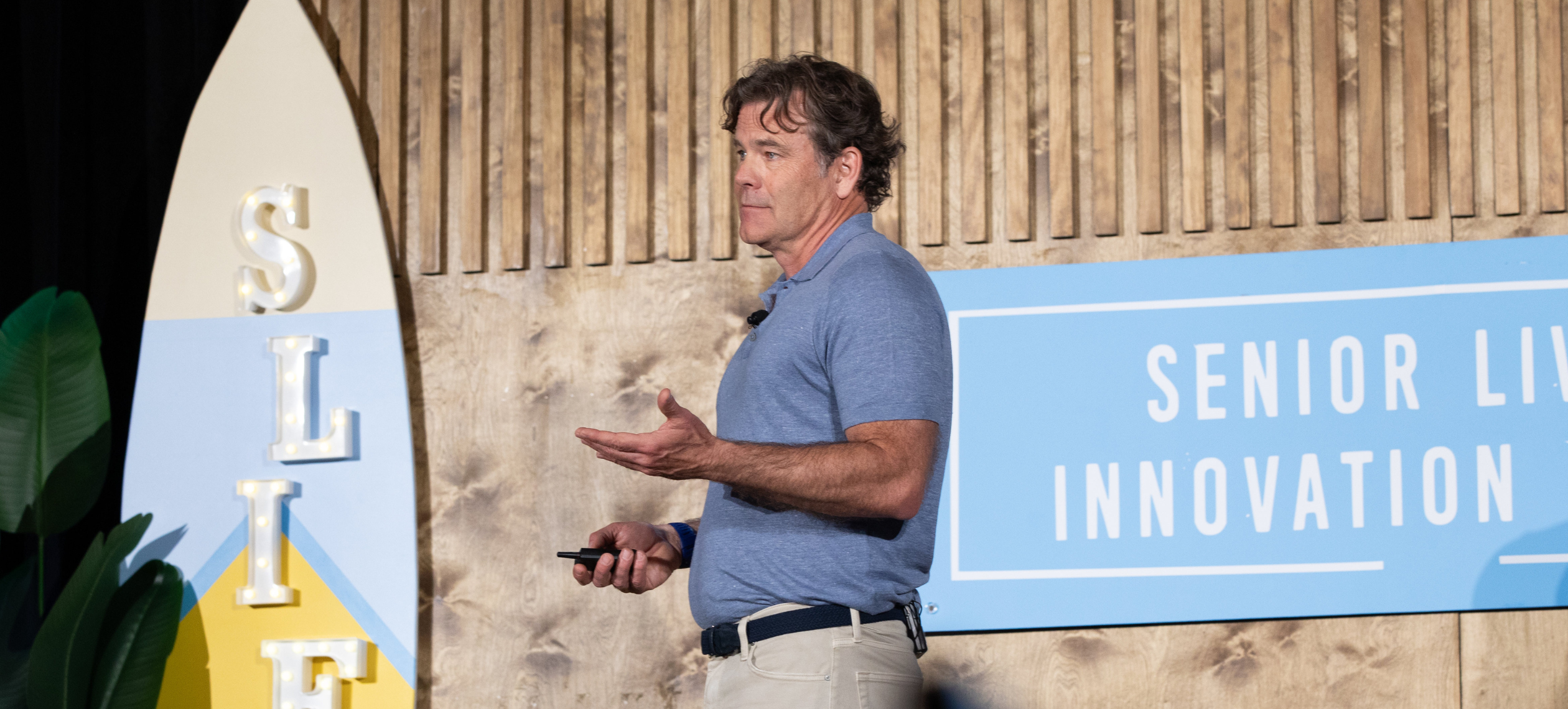
Fee Stubblefield, CEO of The Springs Living, opened his SLIF talk with a math problem the industry can't outrun: over the next five to 10 years, the ratio of workers to older adults is expected to be cut roughly in half, from around one-to-seven today toward one-to-five, even as the customer base grows exponentially. The solution, he argued, isn't found in a booth on the trade-show floor. It starts with how operators see their own frontline staff.
That shift began at his kitchen table. Years ago, his wife, a rural high school English teacher, was frustrated that her students weren't showing up ready to learn, kids from a school where 40% were on free lunch. It dawned on the couple that those same students, once grown, were the people they would potentially hire at The Springs.
And sometimes they did. Stubblefield saw those issues emerge in some of his employees, and witnessed the turnover that followed, at roughly $9,000 per departure, a costly issue.
Stubblefield began seeing these issues through the lens of brain science and privilege. Executive functioning (pushing through adversity) gets built through parents, coaches, and mentors who say "get back in there. Don’t give up. I believe in you" Not everyone had that growing up.
"A meaningful percentage of our employees don't have bootstraps," he said. "In fact, they don't have boots."
That realization exposed the need for a more empathetic view of frontline staff: someone labeled "unreliable" for being late might have lost a ride; someone "flaky" for calling out might have a neighbor who takes care of their child while they work, and who might have had an issue that day that didn’t allow them to.
After several years of research, The Springs launched its Springs Ahead program, built on three pillars: an immediate-needs fund a staff social worker can spend at her full discretion to solve real problems (an electric bill, a deposit); resource-navigation tools connecting employees to services they couldn't otherwise reach; and a paid class giving workers time to think about and plan their lives.
The results inspired Stubblefield. One employee said afterward, "Surprisingly, I'm not as effed up as I thought I was." A 53-year-old worker bought her first home. She later left the company, and Stubblefield's point was that this is fine.
"It's not about loyalty, and it's not about you. It's about them," he said.
Stubblefield closed with a word about "schema," or how we perceive things. The magic in any community, he said, is the "golden line" between employees and residents. In the grand scheme, top leaders at senior living companies don’t serve their residents directly, they serve the employees who do, he said.
His worry is that the industry claims to value employees while its behavior reveals it's often in service to capital. His fix: be "guardians of the galaxy," structure capital and organizations to serve employees, and choose partners carefully.
“A wrong partner in a deal can turn that deal into an ordeal," he said."Our promise is to take care of people. That's messy, and capital doesn't like messy. So find capital that understands messy, and will pivot."
 REQUEST INVITE





-Aug-19-2026-07-53-20-4908-PM.png)

Comments