

 REQUEST INVITE
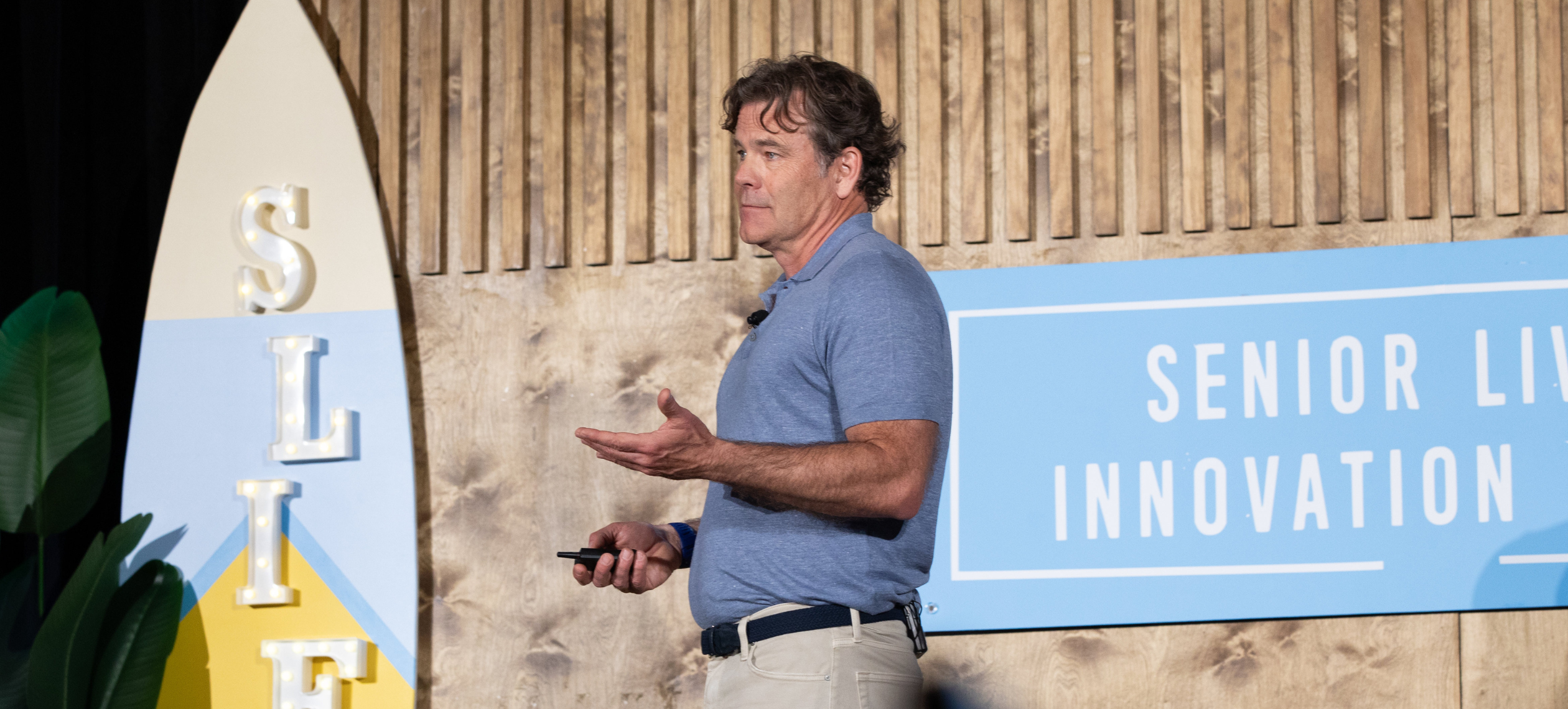
The (not) Late SLIF Show has a way of getting senior living executives to say what they're really thinking. Episode 3 didn't break that streak. Host Murry Mercier brought Joel Theisen, Founder & CEO of Lifespark, and Dr. Bill Thomas, Lifespark's Chief Experience Officer, to the stage for a conversation that ranged from revenue models to residents competing with audience members in a grip strength game on a large LED wall.
Market Penetration Reality
Theisen didn't waste time with platitudes. "Only 2% of seniors use assisted living. 2%."
Let that sink in for a moment. We're fighting over 2% of the market while 98% of seniors are finding other solutions. The industry calls this a "massive opportunity." Theisen calls it what it is: a wake-up call that our current model isn't meeting the needs of the vast majority of older adults.
His journey from venture-backed Silicon Valley startup to building Lifespark from half a million dollars into a nearly $100 million enterprise wasn't about finding ways to monetize the status quo. "I found out that my venture capitalist wanted to take the company into a pure monetization of the current state. And I wasn't cool with that because I care about innovation."
That tension between innovation and iteration, between building something genuinely different versus optimizing what already exists, defined the entire conversation.
The Revenue Problem
When Mercier pushed Theisen on how he views senior living as "archaic," the answer wasn't about outdated facilities or technology. It was about money.
"We're boxed in with market rate reimbursement," Theisen explained. "If I said to you all in this room, if you could double your revenue with the same population, how cool would that be?"
The challenge isn't that senior living communities lack quality care or engaged staff. It's that we're leaving massive revenue on the table by focusing solely on private pay while Medicare and Medicaid spend enormous amounts on the same residents for hospital visits, ER trips, and specialist care that we never capture.
"Unless you have an I-SNP or you have an ACO deal, you're not getting any of it," Theisen said. "We all cry and we're victims. 'Why can't we do this, or why can't we do that? And so I just want to see us do better by compounding that monetary opportunity around each individual."
The COMPLETE Model: Four Revenue Streams, Not One
This is where Lifespark's approach gets concrete. Their COMPLETE senior living model isn't a philosophy. It's an operational and financial framework built on four distinct revenue streams:
- Property Management Excellence
Lifespark operates 47 assisted living buildings, averaging 96% occupancy, when the national average sits at 88%. Strong fundamentals matter. Culture, dining, and resident experience create the foundation. - SPARK Growth and Wellness
World-class, gamified programming platform transforming traditional senior housing lifestyles into personalized, community-building experiences that also aim to keep seniors safe at home. “Community is the ultimate amenity,” said Dr. Thomas - Integrated Medical Group + Urgent Response Services
Lifespark employs their own nurse practitioners and physicians who provide true geriatric medicine. "Nobody wants another colonoscopy or another subspecialist or another visit or another ER trip," Theisen noted.
The medical team acts as trusted advisors to reduce unnecessary healthcare utilization. Engrained in their primary care model is a 24/7/365 medical triage system to quickly address whether a 911 call means deploying a resource to the senior's home or supporting a warm transfer to a hospital when necessary.
“We can diagnose a cardiac event in less than 7 minutes by a cardiologist to make important life decisions according to their wishes before they ever end up in the ER,” said Theisen. - Hospice and Palliative Care
As Theisen bluntly put it, "That business is obviously very lucrative. It's 20% net income."
The model generates revenue from resident fees, value-based care contracts (full upside/downside risk on Medicare Advantage), ACOs, hospice and palliation, and perhaps most intriguing, they charge building owners for "the secret sauce," the programming and culture that drives outcomes. And delivers a better experience for staff and residents/families.
Value-Based Care: The Promise and the Problem
Mercier asked the question many C-suite leaders are wrestling with: Is value-based care helping or hurting the industry?
Theisen's answer was refreshingly honest: "VBC is a great idea, and it's an opportunity for us to actually be predictive and proactive and prescriptive and actually get paid for keeping people healthy. For the first time in my career, after 30 years of doing this... the problem is that the payers and many of the players just basically don't play fair."
Getting the data, proving the outcomes, and actually getting paid for them remains extraordinarily difficult. "It isn't for sissies," Theisen said. "It is a tough, tough dig for anybody that's done it."
But despite the challenges, Lifespark has figured it out. They're operating with full risk arrangements and proving the model works when you have the operational sophistication and risk tolerance to push through the obstacles.
Why Give Away the Secret Sauce?
When Mercier asked why Lifespark is so public about their approach, with four books by Dr. Bill Thomas published on their website and a willingness to share their playbook, Theisen's response cut to the heart of industry collaboration versus competition:
"Why wouldn't we? I hope we can each all win 2% of the market. It's a massive TAM. There are all sorts of opportunities... It takes a village. It takes us all. We spend $5 trillion on acute care in America, and we are pissing away all of our resources. We're not taking care of our workforce, taking care of our families, taking care of our seniors, and we could do so much better."
The subtext: the real competition isn't other senior living providers. It's the acute care system that's capturing all the dollars while delivering inferior outcomes for older adults.
Dr. Bill Thomas: Confronting Internalized Ageism
When Dr. Bill Thomas joined Mercier on stage, the conversation shifted from operational models to philosophical foundations. It was particularly meaningful to have Thomas back at SLIF for the 10th anniversary event. He had been the opening keynote speaker at our inaugural SLIF in 2015, and his return brought the journey full circle.
For those unfamiliar, Thomas is a geriatrician who founded the Eden Alternative and Green House Project, two movements that fundamentally challenged institutional models of elder care. His work has influenced how the industry thinks about person-centered care for decades. Now, as Lifespark's Chief Experience Officer, he's translating those philosophical foundations into operational reality.
Thomas didn't pull punches. "There is a lot of internalized ageism in senior living," Thomas said, "where older people are conceived of as broken versions of their younger selves and that we are cast as a compassionate force that tends to their brokenness. We completely reject that theory. We see the people who are living in the communities we are responsible to as probably the company's greatest asset."
This reframing, from viewing residents as recipients of care to recognizing them as assets, underpins everything Lifespark does. It's why they can invest in programming that traditional operators might dismiss as non-essential. When residents are your greatest asset, investing in their capability and engagement becomes core business strategy, not a nice-to-have.
Rethinking Risk: Downside AND Upside
Thomas introduced a concept that should change how senior living leaders think about risk management. When most operators hear "risk," they immediately think "prevent bad things from happening." Thomas argues that's only half the equation.
"Downside risk is the possibility that a bad thing could happen. We work to keep people out of the hospital, off the sick care rollercoaster, reduce the risk of bad things happening. But that's not all there is to it. We have to create upside risk, and that's the possibility that things could turn out better than we expect."
By addressing residents' fears about hospitalization and over-medicalization, Lifespark opens doors of hope that allow residents to do amazing things. "People need more upside risk," Thomas declared.
The practical application: when residents feel safe and supported in avoiding unnecessary medical interventions, they have the confidence and capacity to pursue purpose, meaning, and growth.
From Wellness to "WEllness"
Thomas made an observation about a presentation earlier in the morning by Disney about their Storyliving communities, where wellness programs focused heavily on individual benefits. "Did you notice when they started talking about wellness? It was about what wellness could do for me."
His reframe: "The word starts with WE. Wellness is a communal function. We believe that aging is a team sport and that when you move into a Lifespark community, you're joining a community and you have an opportunity to be part of a team and to contribute, to be a lifeguard, to change the lives of the people around you."
This isn't semantic wordplay. It's a fundamental shift from viewing residents as individuals to be served to recognizing them as community members with capability and agency.
The Senior Lifeguard Program
One of the most innovative programs Thomas shared was training residents to become certified "Senior Lifeguards." He adapted a fourth-year medical school geriatrics curriculum to teach residents how to monitor and support each other's well-being.
The philosophy: "The more you know, the more you see. And if you see something, say something."
Theisen called it "ambient technology" with a twist: "You don't need AI, you need human intelligence. And you know what I love about it? They (the residents) are always there. They're always watching. They work to make themselves matter."
Thomas teaches the lifeguard curriculum every week across 42 communities through a custom-built telepresence network, making the program scalable without sacrificing the personal connection that makes it work.
The Grip Games
Thomas didn't just theorize about upside risk and community engagement. He brought proof. Thanks to modern technology, the conversation culminated with a live competition between SLIF attendees and The Coyotes, the champion team from Lifespark's Spark Performance League (SPL) Grip Games, who reside at All Saints Senior Living in Shakopee, MN.
The data behind this is solid. Over a seven-week competition across 42 communities involving hundreds of residents, teams increased their collective grip strength by 33%, from an average of 108 liters pumped in week one to 144.6 liters by week seven.
Why does this matter? Grip strength is closely correlated with health, independence, and longevity in the medical literature. More grip strength equals more independence. Less grip strength equals less independence and shorter life.
But here's the smart part: Lifespark made it a competition with a $42,000 purse. Each team pays $1,000 to enter, and winnings depend on performance. The result isn't just a wellness program. It's fierce competition that drives resident engagement and measurable health outcomes.
Every Friday at 1 pm Central, Thomas hosts "The Really Big Show," a SportsCenter-style broadcast covering competition results that airs across all communities via their telepresence network. The level of competition is intense. As Theisen noted, "They are brutal, fiercely competitive and the risk is worth it."
When the championship team appeared on the large LED wall to compete against the SLIF audience, their coach matter-of-factly explained: "The first week everybody thought their thumbs were gonna fall off. But by the time we got to the championship game, everybody wanted to do it again."
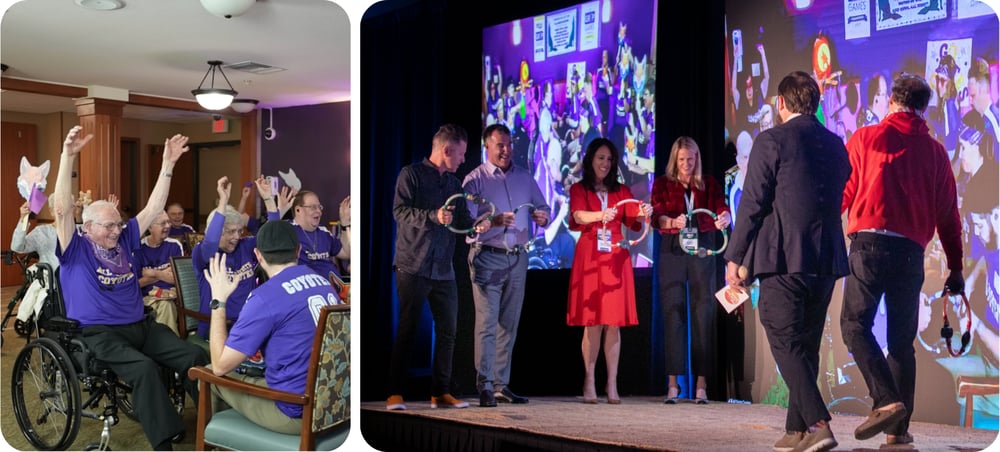 The All Saints Cougars compete with SLIF attendees.
They had built team spirit, cooperation, and genuine fun while delivering clinical outcomes. And yes, the residents absolutely destroyed the industry executives in the competition. 58.3 liters to 38.1 liters. Not even close.
The Bigger Picture
When Mercier asked if Lifespark would expand the Grip Games to other communities, Thomas gave an answer that captured their approach: "What we want to do is enhance strength, purpose, and belonging... It takes a culture to do this. Just this won't do it for you. It's a culture you build."
This is the challenge for senior living operators watching from the outside. The COMPLETE model isn't a program you can buy. It's a fundamentally different way of thinking about residents, risk, revenue, and what senior living communities exist to accomplish.
The question facing C-suite leaders: Are you iterating on the existing 2% market, or are you innovating to capture the other 98%?
Watch the full episode below...

-Aug-19-2026-07-53-20-4908-PM.png)


Comments