

 REQUEST INVITE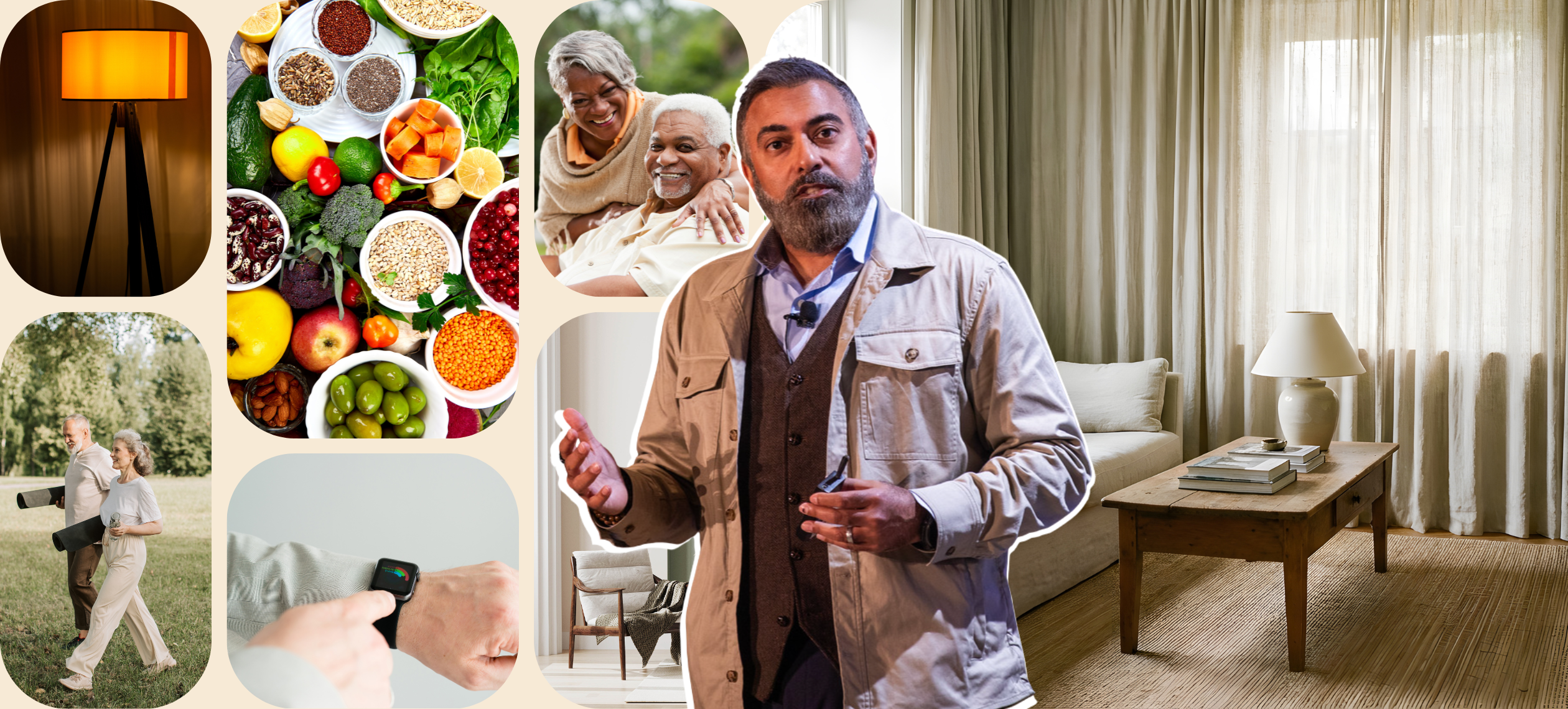
When Dr. Gautam Gulati's father was diagnosed with Alzheimer's in 2012, he had advantages most families don't. They were a family of doctors with access to the best medical care imaginable: The best treatments, the best doctors, the best facilities.
But none of that mattered as much as how his father was able to navigate his home.
At SLIF, Gulati - who goes by Dr. G - shared what he learned as both a caretaker and the founder of The Well Home, the only physician-founded wellness real estate firm designing spaces optimized for health and longevity.
"The best medicine doesn't come from a pill or a device or a hack or a technology. It comes from how we live in our spaces,” he said.
When Clinical Care Isn't Enough
Dr. G's moved his father in with this family, who became his primary caretakers. As physicians, they knew the medical playbook. But questions abounded:
How can lighting, temperature, acoustics, materials, and paint colors impact sundowning agitation? How could they create patterns so he could move independently? How could technology alert them to fall or flight risk?
"Clinical care is absolutely essential," Gulati said. "But the real breakthroughs occurred from simple changes to our environment."
The results? Better agency and independence. Improved quality of life for both patient and caretakers. And most striking: his father's medication list dropped from 12 prescriptions to three, all through environmental changes.
The Personal Becomes Universal
Around the same time, Gulati was neglecting his own health while caring for young kids and aging parents. Symptoms piled up: 40 pounds gained, borderline diabetic and hypertensive, chronic inflammation, and others.
He’s both a physician and a designer, which gave him a unique lens. He applied the same design principles to his own environment, adjusting sleep patterns, eating habits, movement, surroundings. Within two years, he eliminated 100% of those symptoms and conditions without the need for medication.
"What may seem like a personal story is actually one of global transformation unfolding in front of our eyes," he said. Two-thirds of US adults live with one or more chronic lifestyle conditions. We spend over 90% of our time indoors in spaces not designed to optimize human health. Seventy-six percent of that is in our homes.
From Shelter to Therapeutic Systems
Gulati traced the evolution of built spaces: originally shelter from harsh elements, then comfort and convenience during industrialization. "But in the near future, these spaces are going to be reimagined for experiential living, almost like therapeutic systems where environments can sense, react, monitor, and heal."
Three forces are driving this shift:
- Technology advances taking us from reactive sick care to proactive health: wearables, diagnostics, ambient sensors, material sciences, equipment that allows us to be proactive in built structures.
- Increasing understanding of the science of aging and how environment shapes our epigenetics through lifestyle changes.
- Customer desire for experiences over features. "They're no longer buying a list of amenities in a brochure. They're buying better outcomes: a better night's sleep, more social connections, fewer injuries, fewer fall risks."
The Seven Levers of Bioharmony
Gulati developed a framework he calls "the operating system for health in your built environment." These seven levers form the foundation for health, but done incorrectly, they're also the foundation for disease:
- Sleep: Circadian lighting optimized for human biology to help with sleep challenges common in elderly residents.
- Movement: Designs and patterns for micro-nudges of movement, "exercise snacks" to encourage activity instead of La-Z-Boys in every corner.
- Nutrition: Healthy food options impacting cognitive function, making healthy choices the easy choices.
- Connection: Spaces for serendipity and connection, addressing the rise of loneliness.
- Mindfulness: Nature elements (biophilia), wallpaper patterns, layouts that reduce mental chaos and stress.
- Purpose: Experiential programming giving residents meaning, a reason to get up.
- Safety: Beyond physical hazards: invisible factors like air and water quality impacting immune system and brain function.
"Of these seven categories, the two biggest factors for longevity are actually connection and purpose," he said.
Reverse Engineering Outcomes
Dr. G's approach flips traditional thinking: "We need to stop figuring out what set of amenities we need to put in buildings and start asking ourselves what outcomes we want our buildings to achieve, then reverse engineer a plan to select the right amenities."
Practical examples:
To reduce sundowning: Dimmable lights shifting from cool blue to warm amber mimicking outdoor sunlight, combined with clear circulation paths. Result: less agitation.
To prevent falls: High contrast edging on floors plus anticipatory night-lighting. Result: more confidence, agency, fewer incidents.
To combat isolation: Third spaces, "social speakeasys" like favorite bars, cafes, libraries, hotel lobbies. Maybe resident-run cafes. Result: social fabric for essential well-being.
The Bottom Line
"This isn't pipe dream ideas. This is reality," Gulati said. The global wellness economy is $6.3 trillion, with senior living included. "This is no longer a luxury. It's a requirement."
His challenge to the industry: "For decades, we've been designing buildings for shelter, for comfort, convenience. Now we need to reimagine them for experiential living environments that can restore, connect, heal."
Watch his full talk below:

Posted by
SLIF heads to Amelia Island!
The One of a Kind Retreat for Senior Housing Leaders.
November 1-3 | Amelia Island, FL
Learn More
-Aug-19-2026-07-53-20-4908-PM.png)



Comments